
A moving crew reads your boxes the way a driver reads road signs, at speed, while carrying something heavy, usually in poor light inside a truck. Whatever is written on that carton has about one second to communicate where it is going. Everything else about your labeling system is decoration for you to enjoy later.
We are Best of Utah Moving & Storage, and we have unloaded more than 10,000 households since 2013. The gap between a well-labeled move and a poorly labeled one shows up in hours, not minutes. Our local moving crews in American Fork place boxes in the room you specify at no extra charge, but that only works when the box says which room it belongs to.
What a Moving Crew Reads on Your Boxes
Two pieces of information matter at the destination: the room it goes to, and whether it needs careful handling. Everything else is for you, later, when you are unpacking at your own pace. A contents list is useful for finding the coffee maker on day three. It does nothing for the person carrying that carton up a staircase on day one.
Write the room name large enough to read from six feet away, in marker rather than pen. Pen disappears on brown cardboard under warehouse lighting.
A full inventory written in small print across the top flap is invisible to somebody looking at the side of a stacked carton. Put the room first, make it the largest thing on the box, and add whatever detail you want underneath at whatever size suits you.
Where to Place Labels So They Stay Visible
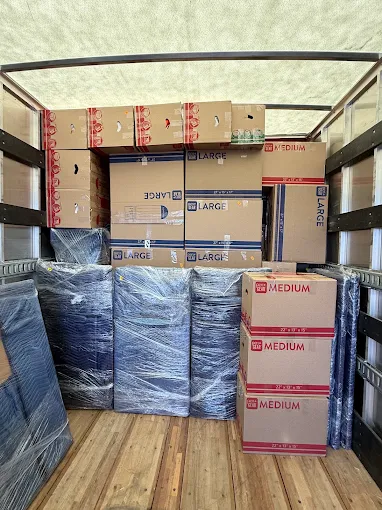
Label at least two sides, never only the top. Boxes get stacked, and once a carton has three others sitting on it, the lid might as well not exist. Two adjacent sides mean the label faces outward whichever way the box ends up oriented in the truck or pushed against a wall at the other end.
Keep the marking in the same position on every carton, ideally the upper third of the side panel. Consistency lets a crew scan a whole stack at once instead of inspecting each box individually, and that is where the real time saving comes from.
Avoid writing across tape seams. The label splits the moment the box is opened, and you lose track of what came from where partway through unpacking.
Building Room Codes That Work at Both Addresses
The common mistake is labeling for the house you are leaving rather than the one you are entering. A box marked spare room means nothing at an address where the spare room is now an office, and the crew ends up asking you about every third carton they carry through the door. Multiply that by 60 boxes, and you have lost an hour standing in a hallway.
Label for the destination from the first box:
- Name rooms as they will exist at the new house
- Number the bedrooms rather than naming them by occupant
- Give the garage and the basement their own codes
- Mark anything bound for storage separately
- Keep the code list on your phone, not on a sheet in a box
Color is the fastest layer to add on top. A strip of colored tape per room reads instantly from across a room, and a matching strip on the door frame at the new house means nobody has to ask anybody anything. Our walkthrough on color-coding boxes by room covers building that system without over-engineering it.
Packing now for an American Fork move?
Tell us how you are labeling when you book, and we will match our placement to your system. The price comes in writing first.
Flagging Fragile, Priority, and Do Not Load Boxes
Fragile has to mean something to be useful. If a third of your cartons carry the word, a crew has no way to tell the wedding china from the throw pillows, and the marking stops carrying information at all. Reserve it for boxes that genuinely need to ride on top with nothing stacked above them, and accept that the number should be small.
Priority boxes deserve a mark of their own. These are the cartons you want off the truck first and open the same night: bedding, the kettle, toilet paper, chargers, and whatever the children need before bed.
Mark them clearly and point them out to the crew lead at the walkthrough so they load last and come off first. Anything traveling in your own car gets marked do not load and staged in a separate room, which pairs with our guide on what to pack last before move day.
How Labeling Shortens Unloading Day
Unloading is where the system pays for itself. A crew that can read destinations straight off the cartons works in a continuous line from truck to room without stopping to ask. A crew that cannot ends up staging everything in the entryway, which is how people finish a move with 60 boxes in a front room and no idea what is in any of them.
The effect carries into the following week too. Boxes that arrive in the right room, right side up, with their contents noted, get unpacked in the order you choose rather than torn open at random, hunting for one specific item.
Our approach to organizing boxes for faster unpacking takes it from there, and the labels you wrote three weeks earlier are what make any of it possible. Documentation practices before a move, including inventory records, are covered in the federal guidance at fmcsa.dot.gov/protect-your-move.
Spend the extra hour on labels before the crew arrives.
Call (385) 380-5600 for a guaranteed written estimate on a move in American Fork, Lehi, Highland, or anywhere across Utah County.
